
Hot water baseboard heater not working? What to check
By DrainX Plumbing · Updated
Short answer
When a hot water baseboard or radiator stays cold, check that zone's thermostat first, then feel whether the pipe going into the heater is warm. One cold room usually points to trapped air or a stuck zone valve. A whole house without heat points to the boiler, the circulator pump or low system pressure.
Why is my hot water baseboard heater not working?
A hot water baseboard goes cold when hot water stops reaching it. The heat comes from a boiler, and a circulator pump pushes the heated water through a loop of pipe to each baseboard or radiator and back. Anything that interrupts the loop leaves the heater cold: a thermostat that isn’t calling for heat, air trapped in the pipe, a zone valve that won’t open, a pump that has stopped, or a boiler that isn’t firing.
Start by working out how much of the house is affected. That narrows the list quickly.
Why is one room cold while the rest of the house is warm?
One cold room or one cold floor usually means a problem in that zone, not at the boiler. The common causes are:
- The thermostat for that zone is set low, switched off or has dead batteries.
- Air is trapped in that section of pipe and water can’t get past it.
- The zone valve for that loop is stuck closed.
- The baseboard’s damper flap is shut, or furniture and curtains are blocking the airflow.
Feel the pipe where it enters the cold baseboard. If the pipe is hot and the room is still cold, look at the damper and the airflow. If the pipe is cold while other zones are hot, the water isn’t getting there.
Why is the whole house cold?
When every zone is cold, look at the boiler and the pump. Check that the boiler’s power switch is on and its breaker hasn’t tripped, and that at least one thermostat is set above room temperature. Then look at the boiler itself. Many show a fault light or an error code when they lock out.
If the boiler is hot but the pipes a few feet away are cool, the circulator pump may have failed. If the boiler is cold and won’t fire, that is a burner or gas problem.
How do you bleed air from a baseboard heater or radiator?
Open the bleed valve until water comes out in a steady stream, then close it. Not every system has bleed valves at the heaters. Where they exist, they are small fittings at the end of a baseboard under the cover, or at the top corner of a radiator.
- Turn the thermostat down and let the system cool, so the water that comes out isn’t scalding.
- Hold a cloth or small cup under the valve.
- Open the valve slowly with a radiator key or flat screwdriver. You’ll hear air hiss out.
- Close the valve as soon as water runs without sputtering.
- Turn the heat back up and check the pressure gauge on the boiler.
Bleeding lets a little water out, which lowers the system pressure. Most systems top themselves up through an automatic fill valve. If the gauge has dropped and stays low, stop there and call.
Many baseboard loops have no bleeders in the rooms at all. Those are purged from valves at the boiler, which is a job for a technician.
Why is my radiator cold at the top or at the bottom?
Cold at the top means air. Air rises and collects at the highest point of the radiator, and hot water can’t fill that space. Bleeding it usually fixes it.
Cold at the bottom means poor flow through the radiator, often from sludge that has settled there over the years. Bleeding won’t help. The system needs flushing.
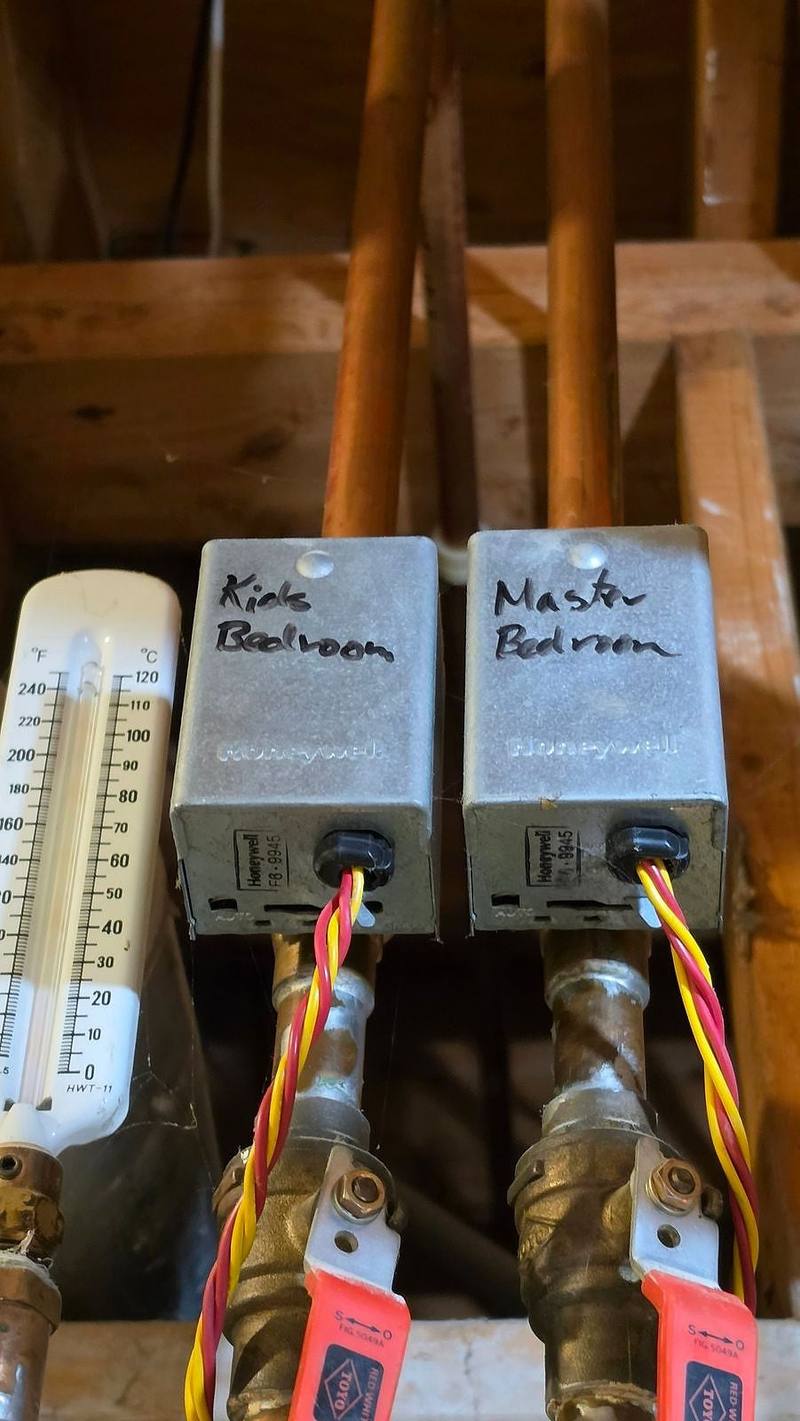
How do you know if a zone valve is stuck?
The thermostat calls for heat, the boiler runs, and that one zone stays cold. Zone valves are small motorized valves near the boiler, one per zone, each wired to a thermostat. When a motor or valve body fails, the valve stays shut.
Two quick checks: the pipe is hot on the boiler side of the valve and cool on the far side, and the other zones heat normally. Many zone valves have a manual lever that opens them by hand. Using it gets heat to the zone for the night, but the valve still needs repair.
How do you know if the circulator pump has failed?
The boiler gets hot and the heat stays at the boiler. A working pump has a faint hum and a slight vibration. A failed one is silent, or it hums loudly and gets very hot without moving water. You may also hear grinding from worn bearings before it stops altogether.
A pump that has quit can let the boiler overheat and shut itself down, so turn the system off and call.
What should the pressure gauge on the boiler read?
On most houses the gauge sits somewhere between 12 and 20 psi while the system is running, though the right figure for your system is in the boiler’s manual. A needle near zero means the system has lost water, and air will get in. A needle climbing toward the red zone means something is wrong with the expansion tank or the fill valve.
Don’t add water or open valves at the boiler unless you know the system. Turn it off and call.
Why are my heating pipes banging or gurgling?
Gurgling and rushing sounds mean air is moving through the pipes with the water. Ticking and creaking are usually pipes expanding as they heat and rubbing on wood framing, which is annoying but harmless. A loud bang when the boiler fires or a zone opens is worth having looked at.
How often should a hydronic heating system be serviced?
Once a year, ideally before the heating season. For the gas side, FortisBC recommends annual service of gas appliances, boilers included, by a licensed gas contractor. The water side should be checked at the same time: system pressure, the expansion tank, the pump, zone valves, air vents and every visible fitting for leaks.
What if the boiler won’t fire or you smell gas?
A boiler that won’t light is a job for a licensed gas contractor. Technical Safety BC requires a gas permit to install or replace gas appliances, boilers among them, so don’t attempt burner or gas valve repairs yourself.
If you smell gas, leave the building and call the FortisBC emergency line at 1-800-663-9911 or 911 from outside.
When to call a plumber
Call a plumber when:
- One zone stays cold after you’ve checked the thermostat and bled any air.
- The boiler is hot and the heat isn’t reaching the rooms.
- The pressure gauge is near zero or keeps climbing.
- There is water under the boiler, the pump or a baseboard.
- The system gurgles all the time, even after bleeding.
DrainX works on the water side of hydronic heating systems: circulator pumps, zone valves, air in the lines, expansion tanks and leaking fittings. Tell us which rooms are cold and whether the boiler itself is running.
Sources
- Appliance maintenance and safety , FortisBC
- Homeowner Gas Permits , Technical Safety BC
- Gas leaks and odour , FortisBC