
How to shut off the main water supply to your house
By DrainX Plumbing · Updated
Short answer
Close the main shut-off where the water line comes in, usually in the basement or crawlspace. Turn a round handle clockwise until it stops, or swing a lever across the pipe. If it's stuck, or water is near outlets or the panel, call your city about the curb stop. In a condo, close your unit shut-off and call the strata.
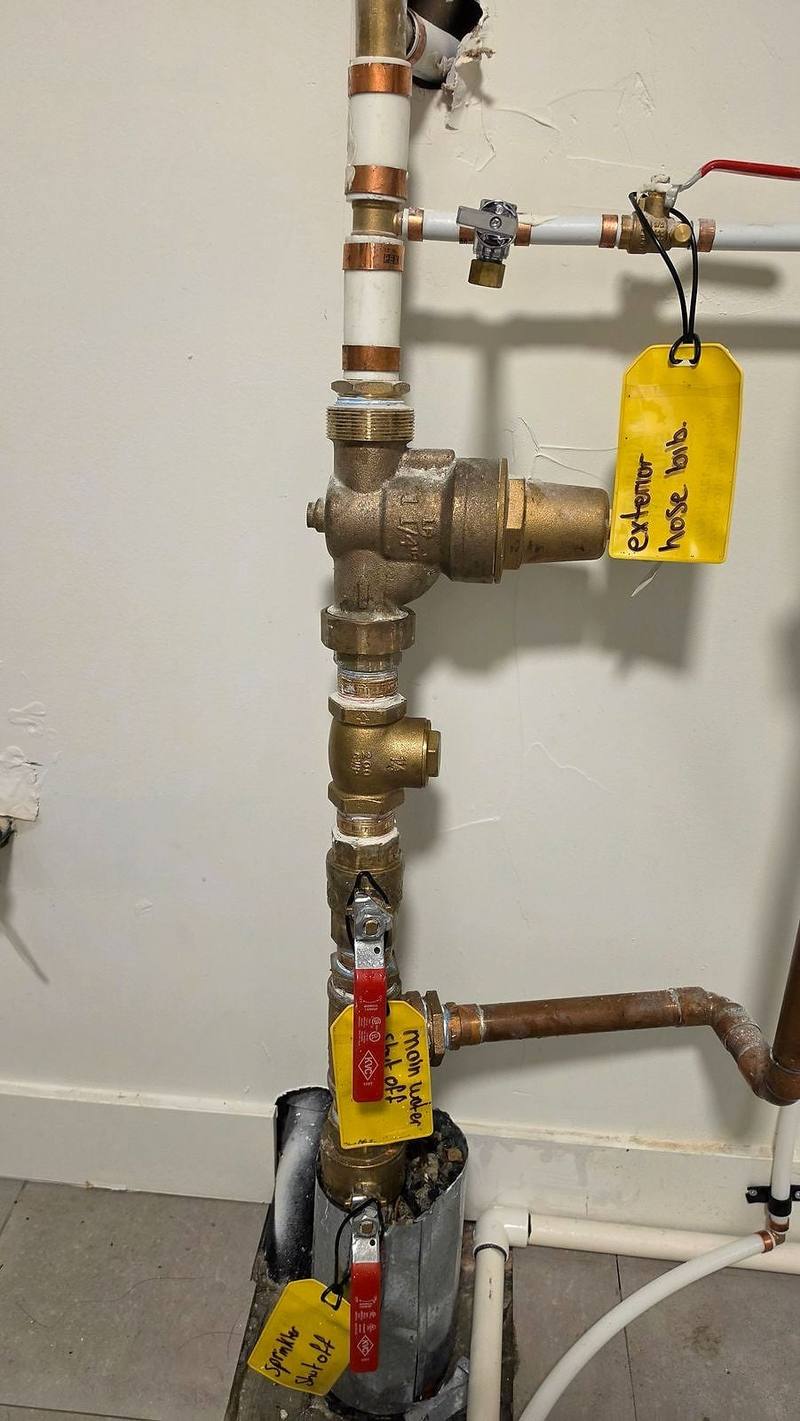
When a pipe bursts, closing the main shut-off valve limits the damage. Find yours now, while the floor is dry.
Where is the main water shut-off valve in a house?
In most houses the main shut-off is where the water line comes in, usually in the basement or crawlspace. The City of Coquitlam’s building FAQ, under “Where is my water, sanitary or storm connection?”, puts it in the same spot and says closing it shuts off water to the house.
Start on the wall facing the street, then check the utility room and around the water heater.
If you still can’t find it, ask your city for its record of your service valve and search the side of the house nearest it. Coquitlam’s water problems page, in its section on shutting off your water service, says the City has valve location records for most homes, made when each house was built. They may not show later changes or the pipe’s route across private property.
What does a main water shut-off valve look like?
The main shut-off is a valve on the incoming water pipe with a round wheel handle or a straight lever.
- A round wheel handle closes when you turn it clockwise (to the right) until it stops, which usually takes several turns. The province’s emergency management blog sums it up as “righty tighty.”
- A lever handle is open when it lines up with the pipe and closed when it sits across the pipe.
If your home has a pressure-reducing valve, don’t mistake it for the shut-off. The City of Coquitlam describes it as a cone-shaped device on your supply line next to the main shut-off. It controls water pressure and doesn’t shut off the water.
How do I shut off the water in an emergency?
Close the main valve by turning the wheel handle clockwise or swinging the lever across the pipe, but only if you can reach it without stepping into water near outlets or the electrical panel. Go in this order:
- Check for electrical risk before you step into any water. BC Hydro says not to enter flooded basements or buildings that may have energized wires or appliances. If water is near outlets or the electrical panel, stay out and don’t touch the panel. From somewhere dry, call 911 if anyone is hurt or in danger, then your city to have the water shut off at the property line.
- Close the valve until it stops. Firm, steady hand pressure is enough.
- Open a cold tap on the lowest floor. If the flow slows to a trickle and stops, the valve is holding.
- Put towels or a bucket under the leak and move your things off the wet floor.
If you smell gas at any point, get out. FortisBC’s gas leak guidance says not to use your cellphone, smoke, light matches or operate electrical switches, and to leave the door open behind you. Once you’re outside, call FortisBC’s emergency line or 911.
What if the main shut-off valve is stuck?
If the main valve won’t turn by hand, don’t force it with a long wrench or a hammer. An old valve that hasn’t moved in years can snap at the stem or start leaking at the packing nut, and then you have a bigger leak you can’t stop.
Work the handle gently back and forth. If it still won’t move, stop the water another way:
- If the leak is at a toilet, sink, appliance or tank water heater, look for a small shut-off on its supply line and close it. On a tank water heater, it’s usually on the cold pipe going into the top. This won’t help with a pipe leaking inside a wall or ceiling.
- In a house, the next valve out is the curb stop near the property line. Port Coquitlam, for one, asks residents to call the City to operate it, so check with your city first.
- In a condo or strata townhouse, call your building manager or the strata’s emergency contact.
Once things are dry, have the stuck valve replaced so it works next time.
When do I need the curb stop?
You need the curb stop, the shut-off valve on your water service near the property line, when the inside valve is stuck or broken or the leak is on the buried line between there and the house. The City of Coquitlam calls it the service valve and says it sits under the lid of a service box.
Rules differ by city. Here are two examples:
- Coquitlam lends water service keys to its residents for a $50 cash deposit, refunded if the key is returned within 30 days, so they can close the service valve themselves. Its engineering and public works line is available 24 hours a day, 7 days a week.
- Port Coquitlam says residents should call the City to operate the curb stop, and that a resident or their plumber who damages one is liable for the repair cost. The City notes this can be a chargeable service.
Coquitlam also says property owners are responsible for all the water pipes starting at the service valve, and the City is responsible for leaks on city property. If you live elsewhere, ask your city where its responsibility ends.
How do I shut off the water in a condo or townhouse?
In a condo or strata townhouse, close your unit shut-off if it has one, then call the building manager or the strata’s emergency contact. Leave the building’s main valve to the strata. Pipes carrying water through the building may be common property, which the province’s strata guide says the strata corporation controls.
Unit shut-offs can be awkward to reach. In one BC Building Code Appeal Board decision, each unit shut-off sat high on a wall behind a screwed-on access panel. Keep a screwdriver handy if yours is behind a panel.
A freehold townhouse usually has its own main shut-off, like a house. In a bare land strata the underground water lines may not be yours, since the same provincial guide says in-ground services such as water are often common property there.
When to call a plumber
Call a plumber once the water is off. If you can’t stop it, call your city to close the curb stop, then call a plumber.
DrainX does emergency plumbing and leak and pipe repair, so we can fix leaking pipes in your home. If the water heater is the source, we can repair it or install a new tank or tankless unit.
Sources
- FAQs , City of Coquitlam
- Water Problems , City of Coquitlam
- City of Port Coquitlam Reminds Residents To Prevent Frozen Water Pipes , City of Port Coquitlam
- Simple ways to prevent your pipes from freezing this winter , Government of British Columbia
- Earthquakes, wildfires, and floods , BC Hydro
- Gas leaks and odours , FortisBC
- Common property and limited common property in stratas , Province of British Columbia
- BCAB 1926 - Accessible location for shut-off valves, residential suites , Province of British Columbia, Building Code Appeal Board